One to one sessions: a sliding scale
I work on a sliding scale of £70 to £130 per hour (about €80 to €150). You choose your amount within that range.
| Session | Your contribution |
|---|---|
| First session, 1.5 hours (recommended) | £105 to £195 (about €125 to €230) |
| Following sessions, 1 hour | £70 to £130 (about €80 to €150) |
| Longer sessions, 1.5 hours, when you’d like more time | £105 to £195 (about €125 to €230) |
How to choose your amount
I invite you to consider your financial access, your wish to help me create more spaces of connection and healing, and your appreciation for my time, energy and everyday living costs.
The lower end is there if money is tight at the moment. The middle of the range is what sustains my practice. The upper end, if you’re comfortable, helps keep lower rates available for others.
Two free places each month
I keep two sessions a month completely free for people facing serious financial hardship. If that’s you, write to me. Together we’ll see how I can help: one of these sessions, a place on the waiting list, or finding other support that suits you.
Events and retreats
Events and retreats have fixed prices, shown on each event, for clarity and ease. See upcoming events.
Groups
The London NVC Men’s Group runs on a gift economy, and the NVC Online Men’s Group is free.
The Paradigm of Gift Economy
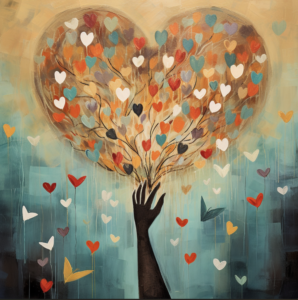
Before the transition to settled societies, we most likely accessed resources freely as hunter-gatherers, just as some of the few remaining indigenous groups do today.
Food was available in nature, and shelter and human care were provided by the community with an understanding of our interconnected nature. There was no concept of paying for anything; everything was given as a gift. If you had children and needed help raising them, the community would help. If you needed emotional or mental support, evenings around the fire or the wisdom of elders would provide that. Belonging was not about money but about how much one contributed to the tribe. It was all about gifting, as we knew that contributing to the tribe benefited each individual and vice versa.
A gift economy is rooted in the idea that goods, services, and support are given without a fixed expectation of repayment. Instead of treating value as something to be exchanged equally, it recognizes that wealth flows best when it moves, nourishing the community as a whole.
In contrast to market transactions, which create clear separations between giver and receiver, a gift economy weaves people together in relationships of trust and gratitude. When we give freely, we acknowledge our interdependence and participate in a cycle of generosity that transcends financial exchange.
Much of my work is inspired by these principles. While I do use structured exchange for some of my offerings, I also create spaces where people can engage through the gift economy.
For certain events and experiences, I do not set a fixed price. Instead, participants are invited to contribute in a way that feels meaningful and joyful for them, with the understanding that their support helps sustain both me and others who may not have financial means. My request is that my direct costs (such as travel, venue, or materials) are covered.